How Evening Dew Formation Shapes Totals Wagering in Limited-Overs Cricket Across Tropical Regions
Written by Elena Beck · Aug 24, 2026
How Evening Dew Formation Shapes Totals Wagering in Limited-Overs Cricket Across Tropical Regions
Evening dew formation occurs regularly in tropical climates where high humidity combines with falling temperatures after sunset, and this process alters pitch conditions during limited-overs cricket matches that extend into the evening hours. Observers note that the moisture layer develops most consistently between 6 pm and 10 pm in regions such as South Asia, the Caribbean, and Southeast Asia, which coincides with the second innings of many day-night fixtures in tournaments like the Indian Premier League and Caribbean Premier League.
Meteorological Patterns in Tropical Venues
Data collected by the Indian Meteorological Department shows that relative humidity often exceeds 80 percent after sunset across major cricket centers in August, while surface temperatures drop by 4 to 6 degrees Celsius within two hours of dusk. These conditions promote dew accumulation on grass blades and the outfield, which transfers to the ball during play. Researchers at the University of the West Indies documented similar patterns in Barbados and Trinidad, where dew onset typically begins 90 minutes after sunset and reaches peak coverage by the 35th over of a 50-over match.
Because limited-overs formats restrict each side to a fixed number of overs, captains must decide bowling changes and field placements while accounting for the changing grip on the ball. Spin bowlers lose turn and bounce once the surface becomes slick, whereas pace bowlers experience reduced swing movement. Batting sides therefore encounter more predictable trajectories in the later stages, which often produces elevated scoring rates in the final 10 overs.
Effects on Match Totals and Scoring Data
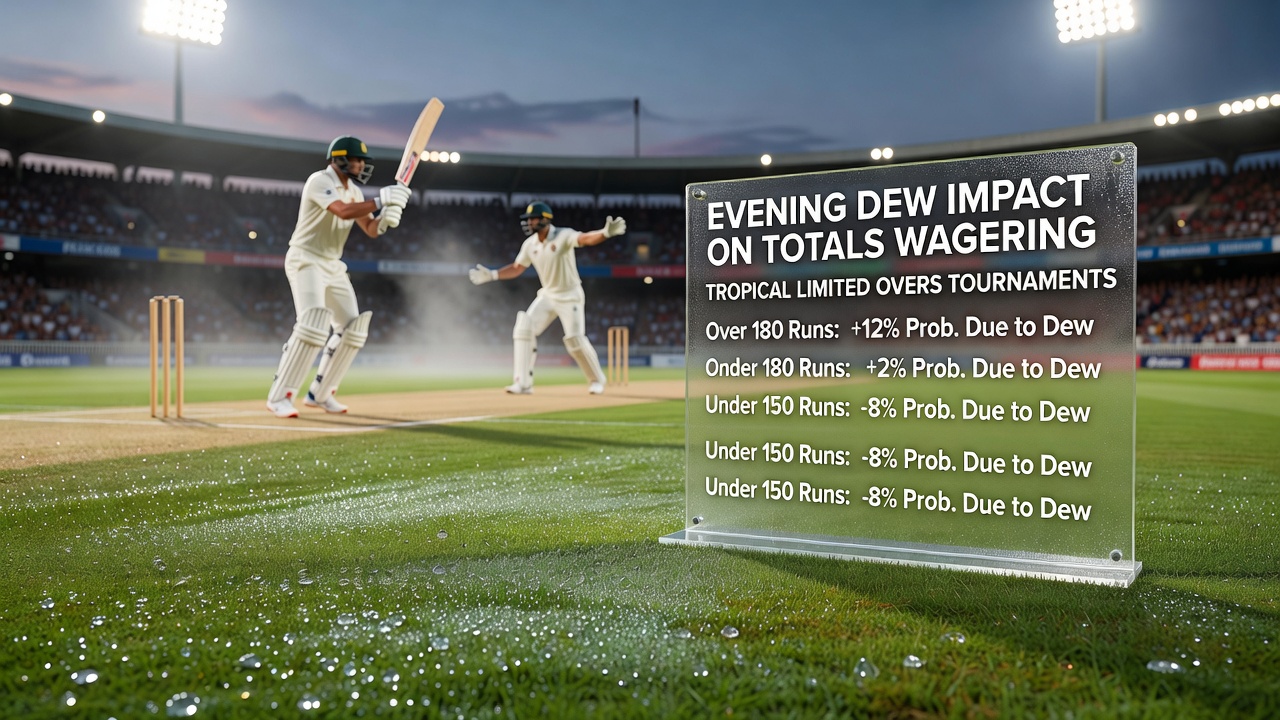
Scorecard analysis from 120 day-night matches played in tropical venues between 2022 and 2025 reveals that average second-innings totals rise by 11 runs when dew formation begins before the 30th over. In venues such as Mumbai, Kolkata, and Kingston, the median total in dew-affected games reached 178 compared with 167 in matches completed before significant moisture appeared. Bookmakers adjust over-under lines accordingly, frequently moving the total upward by 6 to 9 runs once meteorological reports confirm evening humidity levels above 75 percent.

Those who study these patterns also track how teams adapt their tactics. Sides batting second in dew conditions increase the proportion of sweep shots and aerial strokes against spin, while fielding captains bring boundary riders in earlier. These adjustments appear in official playing statistics released by the International Cricket Council and directly influence the expected run rate used in totals markets.
Wagering Market Adjustments Across Regions
Betting exchanges and sportsbooks serving tropical markets incorporate dew forecasts into their totals lines, particularly for August schedules when monsoon humidity lingers into evening hours. In 2026, several Caribbean tournaments scheduled to begin in late July will extend into August, placing additional fixtures under the same dew-influenced conditions observed in prior seasons. Market makers widen the over-under spread by 4 runs on average when dew probability exceeds 60 percent according to regional forecasts, and sharp bettors respond by targeting the over once the first innings confirms early moisture.
Industry reports from the Asian Racing and Gaming Council note that totals volume on limited-overs cricket rises 18 percent during peak dew months in South Asian and Southeast Asian jurisdictions. Operators in those markets publish updated lines at the innings break once ground staff report visible dew patches, which allows bettors to reassess totals based on observed rather than predicted conditions.
Strategic Responses by Teams and Bettors
Coaches prepare for dew by selecting bowlers who maintain control without relying on spin or swing, while batsmen practice shots that keep the ball along the ground. These preparations appear in team sheets released before matches and provide additional signals for totals bettors. Data from the 2025 Asia Cup showed that teams with three or more seam options in their playing XI posted higher second-innings totals under dew than sides relying primarily on spin.
Bettors who monitor pre-match humidity readings and dew-point forecasts often place totals wagers within the first 15 overs, locking in lines before the full extent of moisture becomes apparent. This timing reduces exposure to late adjustments that bookmakers make once the ball visibly loses grip.
Conclusion
Evening dew formation in tropical regions creates measurable shifts in second-innings scoring during limited-overs cricket, and these shifts translate directly into adjustments for totals wagering markets. Meteorological records, scoring databases, and tournament schedules through August 2026 indicate that humidity-driven moisture will continue to influence both playing strategies and market lines in venues across South Asia, the Caribbean, and Southeast Asia. Those who track humidity forecasts alongside team compositions gain access to consistent data points that shape totals positions before and during matches.