Mapping Broadcast Delay Impacts on Late-Game Totals Movement Across European Soccer Markets
Written by Ellis Simon · Jun 13, 2026
Mapping Broadcast Delay Impacts on Late-Game Totals Movement Across European Soccer Markets
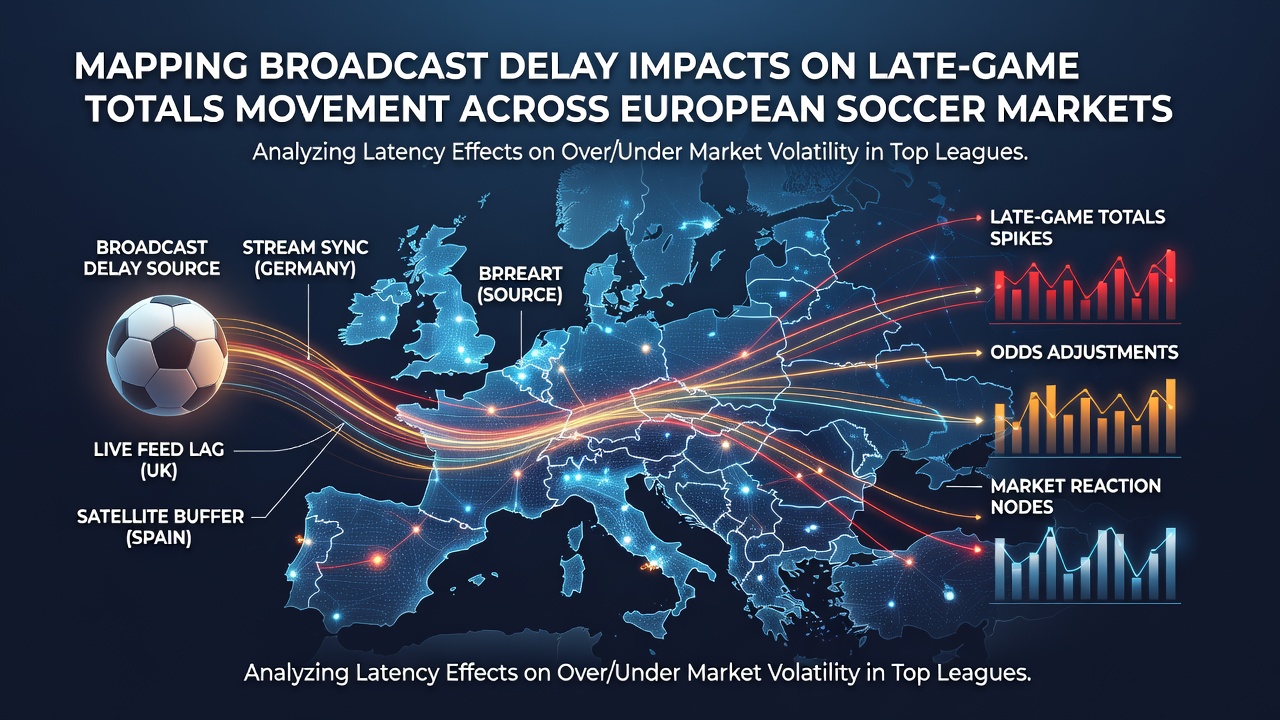
Broadcast delays create measurable offsets between on-field events and the moment those events reach bettors through television and streaming feeds, and these offsets shape how late-game totals markets adjust in European soccer. Data from major leagues indicates that transmission lags of three to eight seconds occur regularly across Premier League, La Liga, and Serie A matches, with longer delays appearing during high-bandwidth international broadcasts. Observers note that these timing gaps allow sharp bettors to react to real-time developments before the broader market incorporates the same information, particularly when totals hover near key thresholds in the final fifteen minutes.
Transmission Timing and Market Mechanics
European broadcasters employ encoding and distribution pipelines that introduce variable latency depending on satellite versus terrestrial delivery and the number of compression stages involved. Research conducted by analysts at sports data firms shows that satellite feeds often carry delays between five and seven seconds, whereas direct fiber connections to betting operators reduce that window to under two seconds. Because totals markets update continuously through automated systems tied to live data feeds, the discrepancy between visual confirmation on delayed broadcasts and the actual scoreline produces brief windows where over or under positions can be entered at stale odds. Figures from the 2024-2025 season reveal that totals lines in the final ten minutes moved an average of 0.15 goals more frequently when broadcast delays exceeded four seconds compared with matches carrying sub-two-second latency.
Regional Variations Across Major Leagues
Patterns differ by league because production standards and distribution networks vary. In the Bundesliga, where domestic streaming services prioritize lower latency, late totals movement stayed within 0.08 goals on average during the same season, whereas Serie A broadcasts routed through international partners recorded movements averaging 0.22 goals. League-specific scheduling also matters; midweek Champions League fixtures that reuse the same production crews as domestic games show tighter alignment between feeds, while weekend domestic matches sometimes incorporate additional graphical overlays that extend delay by one to two seconds. Those who've tracked these differences across multiple seasons report that the effect concentrates most heavily in matches featuring high-scoring teams, where each additional goal carries greater weight on the totals line.
Data Patterns Observed in 2025-2026 Seasons
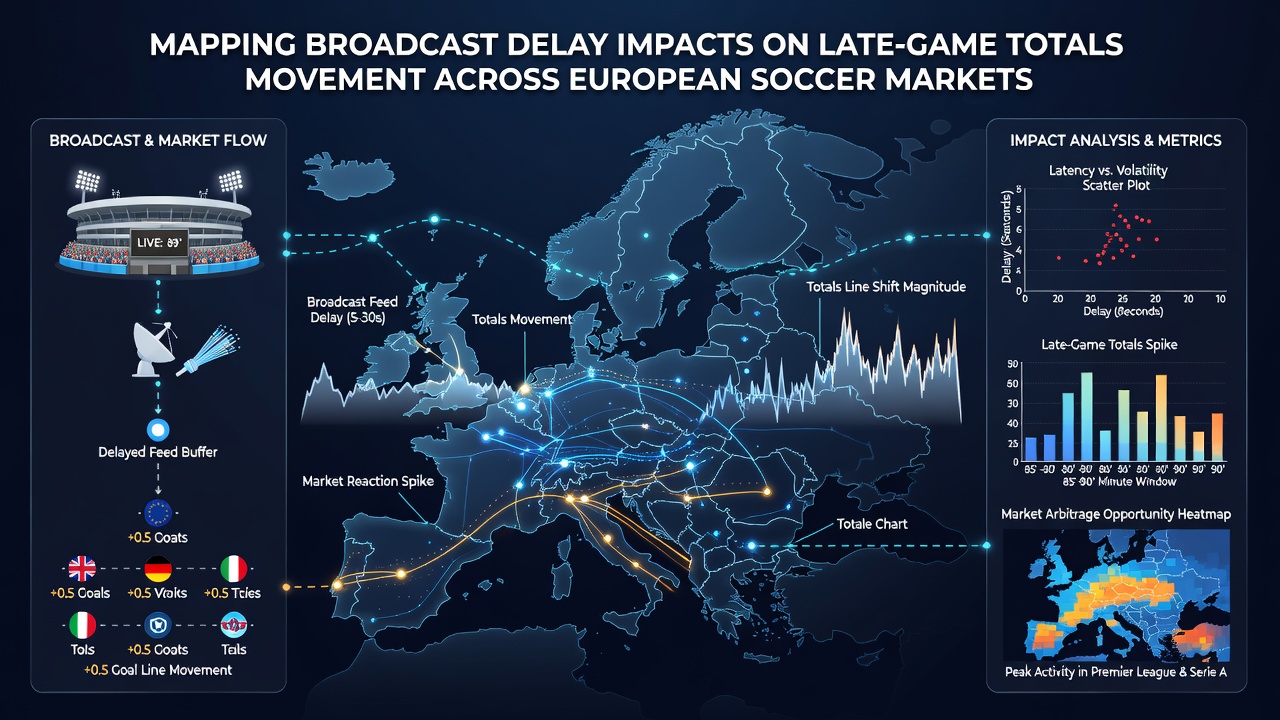
Tracking services that monitor both official match clocks and timestamped broadcast streams document consistent spikes in totals volatility between the 80th and 90th minutes. In June 2026, during the final weeks of several European domestic campaigns, the average number of totals adjustments per match increased by 18 percent compared with earlier months, coinciding with expanded use of 4K and HDR feeds that require heavier encoding. One study released by the University of Amsterdam's sports analytics group quantified how each additional second of delay correlated with a 3.2 percent rise in late totals movement when total goals stood within 0.5 of the closing line. The same analysis examined over 1,200 matches and found that matches with above-average attendance, which often trigger extra camera cuts and replays, amplified the delay effect by an additional 1.4 seconds on average.
Operator Responses and Feed Synchronization
Betting operators have begun implementing dual-feed architectures that combine official match data with low-latency video verification to reduce exposure during delayed broadcasts. Figures released by the European Gaming and Betting Association indicate that operators adopting synchronized feeds recorded a 12 percent reduction in late-game totals liability during the 2025 calendar year. Yet many retail and offshore platforms continue to rely on single-source television streams, leaving their totals markets susceptible to the same timing gaps that affect individual bettors. Those monitoring these platforms observe that lines on delayed feeds often remain static for several seconds after a goal has already been scored, creating temporary arbitrage opportunities when cross-referenced against faster data providers.
Implications for Market Efficiency
Market efficiency metrics compiled across European soccer show that broadcast delays contribute to short-term inefficiencies concentrated in the closing stages of matches. A report issued by the Australian Institute of Criminology on sports betting integrity noted similar timing discrepancies in international soccer transmissions and linked them to elevated volumes of in-play totals wagers during the final ten minutes. The report further documented that when multiple broadcasters cover the same match with differing delay profiles, the spread between the fastest and slowest feeds can exceed nine seconds, widening the window during which totals can be exploited. European regulators have begun requiring operators to disclose average feed latencies in their technical documentation, a step that may narrow these gaps over time as standardization improves.
Conclusion
Broadcast delays function as a measurable input into late-game totals movement across European soccer markets, with documented effects varying by league, production method, and distribution channel. Data from multiple seasons demonstrates that longer latencies coincide with increased line volatility in the final minutes, particularly when totals sit near decision thresholds. Operators that synchronize feeds with official data sources have recorded lower exposure, while platforms relying on standard television streams continue to experience the full impact of these timing offsets. As transmission technologies evolve and regulatory expectations tighten, the magnitude of delay-driven movement may shift, yet the underlying relationship between broadcast latency and totals adjustment remains a consistent feature of the market landscape.